Skype: neodalle-travel
Tel: +86 135 7447 2266
E-mail: sales@zhangjiajieholiday.com
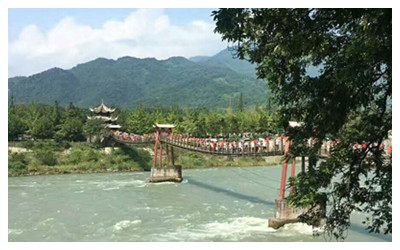 Yellow River, also Huanghe River, known in Chinese literature simply as the He (“River”)—turns eastward (immediately after its confluence with the Wei River) just west of the junction of the borders of Shaanxi, Shanxi, and Henan. From there it soon enters the Sanmen Gorge, flowing east-northeast for some 80 miles (130 km) between Shanxi and Henan before issuing onto the plain and flowing east directly across northern Henan. It is remarkable that from the confluence with the Wei to the sea, a distance of about 600 miles (1,000 km), the Huang He receives only two comparatively small tributaries: the right-bank Luo River, on which Luoyang stands, and the left-bank Qin River.
Because the watershed between the Huang and Huai rivers is almost imperceptible, the Huang He has radically changed its course several times in the last three millennia, flowing to the sea first south, then north of the Shandong Peninsula. The diversion has always been in northern Henan between Zhengzhou and Kaifeng. In 1938, in an attempt to arrest the advance of the invading Japanese Army, the Huang He was deliberately diverted to the south by blowing up the dikes near Zhengzhou and flooding 21,000 square miles (54,000 square km) of land, at an estimated cost of 900,000 lives. The river was restored to its former northern course in 1947.
Under the People’s Republic, work along the river has included continued strengthening of the dikes and construction of the 30-mile- (50-km-) long People’s Victory Canal, which diverts Huang He water to the Wei River (of northeastern Henan). A dam near the city of Sanmenxia near the Shanxi border was begun in 1956 as part of an extensive flood-control and hydroelectric project. After completion of the dam in the 1970s, silt accumulation cut its generating capacity to a fraction of planned output, hampering much of the province’s industrial development; however, the dam did help control the flood stages of the river.
 Ask Questions ?